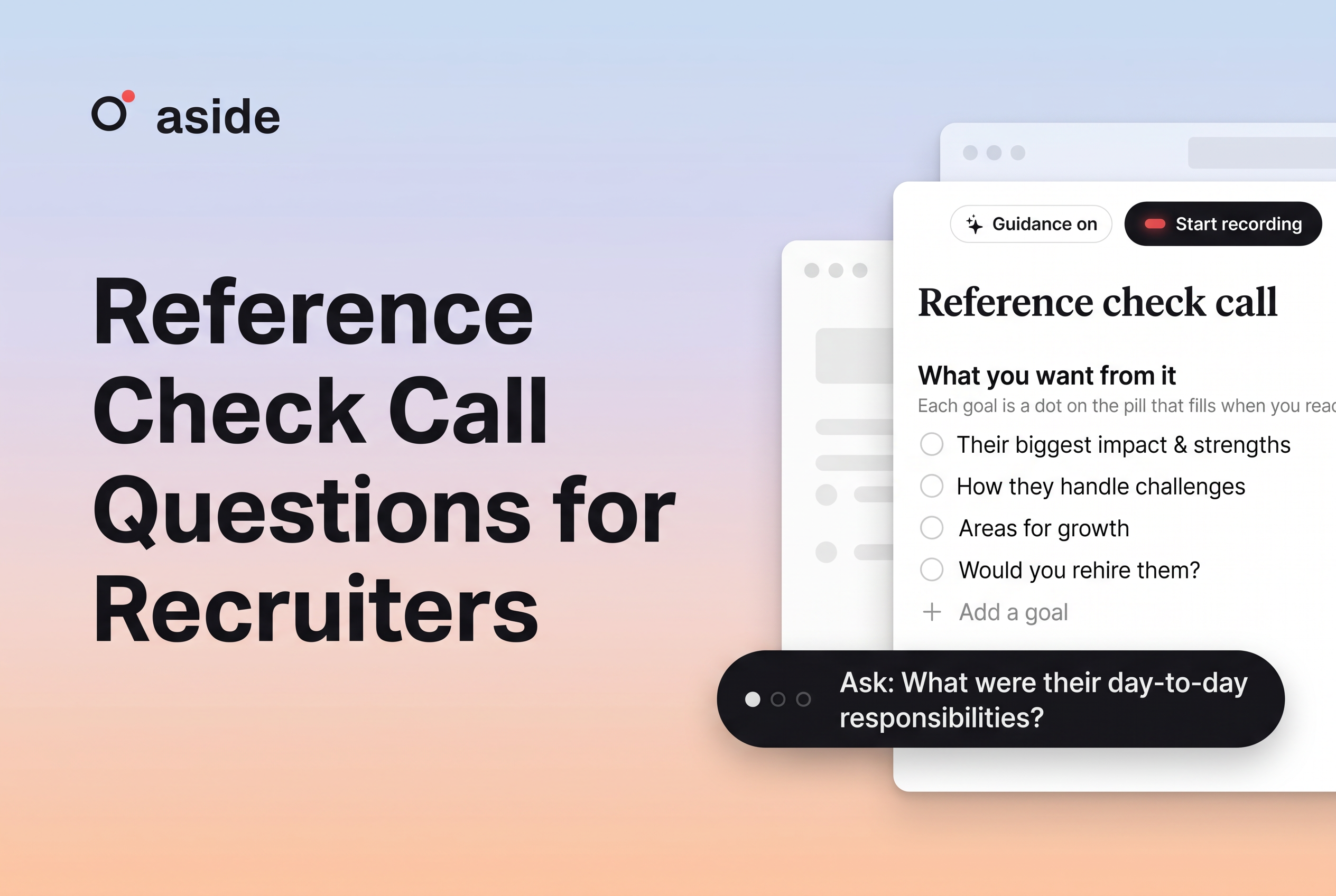
The best reference check call questions are job-related, asked in a fixed order, and put to a referee the candidate has agreed you can contact: confirm the facts, then probe performance, then close with an open question about working together again. Run it that way and you get usable evidence in ten to fifteen minutes without wandering into territory that can land you in trouble.
This post gives agency recruiters in the UK and Ireland a script you can run line by line. It covers what to ask, what a strong answer sounds like compared with a hedge, which questions to leave out, and how a reference check differs from a background check. Nothing here is legal advice. If a case gets difficult, get a proper opinion from an employment lawyer or your trade body.
Before you dial: get the candidate's permission and set the scope
Get the candidate's agreement before you contact any referee, and never ring a current employer without it. UK guidance points the same way: request references at the final stage, ideally after a conditional offer and with the applicant's permission, and ask only for information needed for the recruitment decision (UK government employer guidance, 2026).
Consent is only part of the data protection picture. A reference involves personal data, but consent is not automatically the lawful basis under GDPR. An employer can rely on legitimate interests to receive and hold a reference, and the processing still has to be fair, transparent, relevant and proportionate. In practice that means two things for you:
Tell the candidate who you will call, what you will ask and what you will do with the answers.
Write the questions before you dial. If a question is not tied to the role, cut it.
Set the scope with the referee in your first thirty seconds too. Say who you are, which candidate you are calling about, that the candidate has given permission, and how long you need. Referees relax when they know the call has a clear edge. A referee who is allowed to give a neutral, facts-only reference can do so, so don't push for opinion they aren't comfortable giving.
The reference check call questions to ask, in order
Ask the questions in this order: facts first, performance second, people and risk third, an open close last. Easy factual questions warm the referee up and make the harder ones feel natural.
1. Confirm the basics. "Can you confirm that [candidate] worked with you as [job title] from [start date] to [end date]?" Check the title and dates against the CV. This is the one part of the call where a yes or no is enough.
2. Establish the relationship. "How do you know the candidate, and how long did you work together?" It tells you how much weight to give everything that follows. A line manager of three years outranks a colleague from one project.
3. Ask about the role itself. "What were their main responsibilities, and what did they own day to day?" Compare it with what the candidate told you on the screen.
4. Ask for a specific result. "What was the most significant thing they delivered while working for you?" Get a real example with a number or an outcome in it. This is the single most useful question on the call.
5. Ask about strengths against the vacancy. "This role involves [two or three real requirements]. How did they perform on those?" Name the actual duties. Vague questions get vague answers.
6. Ask about development areas, phrased neutrally. "What would help them do even better in their next role?" It's gentler than "what are their weaknesses?" and referees answer it more honestly.
7. Ask about working with others. "How did they work with colleagues, clients or direct reports? How did they handle pressure or disagreement?"
8. Ask about reliability. "How was their reliability and quality of work? Any recent, relevant performance or conduct matters you are able to share?" Keep it recent and relevant to the job.
9. Ask about the exit. "Why did they leave, or what is the reason for the move?" Compare it with the candidate's story. Don't push if the referee declines.
10. Close with the rehire question. "Would you work with them again, and in what capacity?" Then add: "Is there anything else I should know that would help me place them well?"
Ten questions, roughly twelve minutes. If you only have time for four, keep numbers 1, 4, 5 and 10.
What to listen for: strong answers, hedges and silence
A strong answer is specific, unprompted and comfortable. A weak one is short, generic or suspiciously careful. How the referee answers tells you as much as what they say.
Strong: "She took over our largest account in March, grew it by about a fifth by year end, and trained two juniors along the way." Dates, scale, named outcomes. You can write that down and check it.
Hedge: "Yes, he was fine. Did what was asked." Nothing is wrong with it, and nothing is right with it either. Follow up with "Can you give me an example?" A good referee will find one. A reluctant one will stall.
Faint praise: "Always turned up on time." If punctuality is the headline compliment for a senior hire, that tells you something.
Silence or a long pause before the rehire question. Don't fill it. Count to five in your head. The next thing the referee says is usually the honest part.
A very quick "yes" to everything. Probe with "What would you want to flag to a new manager?" Generic enthusiasm without a single detail shouldn't carry the same weight as one concrete story.
One rule keeps you fair: opinions need evidence. References have to be accurate and fair, so if a referee offers a damaging opinion with nothing behind it, ask what it's based on before you write it down, and never pass an unsupported remark to a client as fact.
Questions to leave out: protected characteristics and unfair opinions
Leave out anything that isn't about doing the job, and everything that touches a protected characteristic. Under the Equality Act, a reference must not disadvantage a candidate because of disability, pregnancy, race, religion, age, sex, sexual orientation or other protected characteristics (ACAS and UK government guidance, 2026). Don't ask the referee about those, and don't repeat them back if the referee volunteers them.
Skip these:
"Do they have any health problems?" or "How much sick leave did they take?" Before an offer, health and disability questions are off limits except for narrow permitted purposes, such as arranging adjustments for an assessment.
"Are they planning a family?" or anything about pregnancy or maternity.
Questions about age, religion, ethnicity, marital status or sexuality, however casually phrased.
"Would they fit in with the team?" in its vague form. It invites bias. Ask about specific behaviours instead.
Gossip, rumours and personal life.
If a referee volunteers something sensitive, don't follow it up and don't record it. Say "I'll stick to the job-related side" and move on. Keep equality-monitoring data separate from anything the hiring decision-maker sees. Irish recruiters should apply the same discipline under the Employment Equality Acts, which cover similar grounds.
The test is simple: could you defend this question to the candidate's face by pointing at the job description? If not, don't ask it.
Reference check vs background check: what each covers
No, a reference check is not the same as a background check. A reference check asks people who worked with the candidate about their performance, conduct and reliability. A background check verifies facts through records and third parties: identity, right to work, qualifications, criminal record checks where the role legitimately requires them, and sometimes credit or directorship searches.
| Reference check | Background check | |
|---|---|---|
| Who you ask | Former managers, colleagues, clients | Records, registries, official bodies |
| What it tells you | How they performed and worked | Whether stated facts and eligibility hold up |
| Typical content | Role, dates, results, working style, rehire view | Identity, right to work, qualifications, relevant criminal record |
| Nature of the answer | Opinion plus facts | Mostly verified facts |
| Who runs it | Often the recruiter, by phone | Often a screening provider or the client |
They complement each other. A clean background check says nothing about whether someone is good at the job, and a glowing reference says nothing about whether their certificate is real. Agree with your client which of the two they want from you, because the compliance rules differ. Criminal record checks in particular depend on the role and the lawful basis, so don't run them as a routine add-on.
Taking notes and keeping the call on track (including a live call assistant with no bot)
Take notes in the referee's own words, not your paraphrase, and keep them to job-related facts. Typing while listening is where reference calls go wrong: you miss the pause, skip the follow-up and end up with a tidy page of nothing.
A few habits help:
Put the ten questions on screen before you dial and tick them off.
Write short direct quotes for the two or three answers that matter.
Mark each answer as fact, opinion with evidence, or opinion without evidence.
Tell the referee if you are recording or taking detailed notes. Don't record without telling them.
If you want help during the call, Aside is a Mac and Windows app that records calls on your computer, writes up notes, goals reached and next steps, and optionally gives live guidance. No bot joins the call, which matters on a reference call where the referee is already a little wary. English and 24 European languages are transcribed on your computer, and nothing is used to train AI models.
It doesn't change the compliance rules. You still need the candidate's permission, the referee still decides what to share, and you still keep your questions to the job. For the wider picture of recorded recruiter calls, see AI Notetaker for Recruiters: Candidate Screens Without a Bot, and for question structure on earlier calls, Recruiter Phone Screen Questions: What to Ask and When.
Run the same ten questions every time, then let Aside carry the script
Consistency makes a reference check fair and useful: the same ordered questions, a referee who knows the scope, a candidate who has said yes, and nothing that strays from the job. Put your ten questions into a one-page script today and use it on your next reference call. If you want live guidance while you listen, install Aside on your Mac or Windows PC and try it on that call. New accounts get 14 days of Pro with no card.
Questions
I was rejected after a reference check. What should I do?
Ask the employer or recruiter for feedback in writing, politely and without blame. You can request a copy of the reference as personal data, though a genuinely confidential reference may be exempt. If you think it was inaccurate or unfair, tell the referee and the employer. If you suspect discrimination on a protected characteristic, seek advice from ACAS or an employment adviser.
What is a personal reference, and can I use a friend as a referee?
A personal reference, or character reference, comes from someone who knows you outside work, such as a mentor or community leader. A friend is a weak choice for most roles, because employers want evidence of work performance. Use a friend only when you have no work history, and prefer someone who can speak to relevant skills, not just your personality.
What makes a good reference?
A good reference is specific, recent, honest and tied to the role. It names responsibilities, gives at least one concrete result, and comes from someone who supervised or worked closely with the candidate. It confirms dates and job title accurately and avoids irrelevant personal details or opinions without evidence behind them.
Is a reference check the same as a background check?
No. A reference check asks former managers or colleagues how the candidate performed and behaved. A background check verifies facts through records, such as identity, right to work, qualifications and, where the role justifies it, criminal record. Recruiters often run both, but they answer different questions and carry different compliance rules.
Does Aside join the reference call as a bot?
No. Aside is a Mac and Windows app that records on your computer with no bot joining the call. It can optionally give live guidance, then write up notes, goals and next steps afterwards. Audio is transcribed on-device by default, but it may be uploaded for transcription if cloud transcription is enabled, the computer cannot keep up, or an unsupported language is used. You still need to tell the referee you are recording.