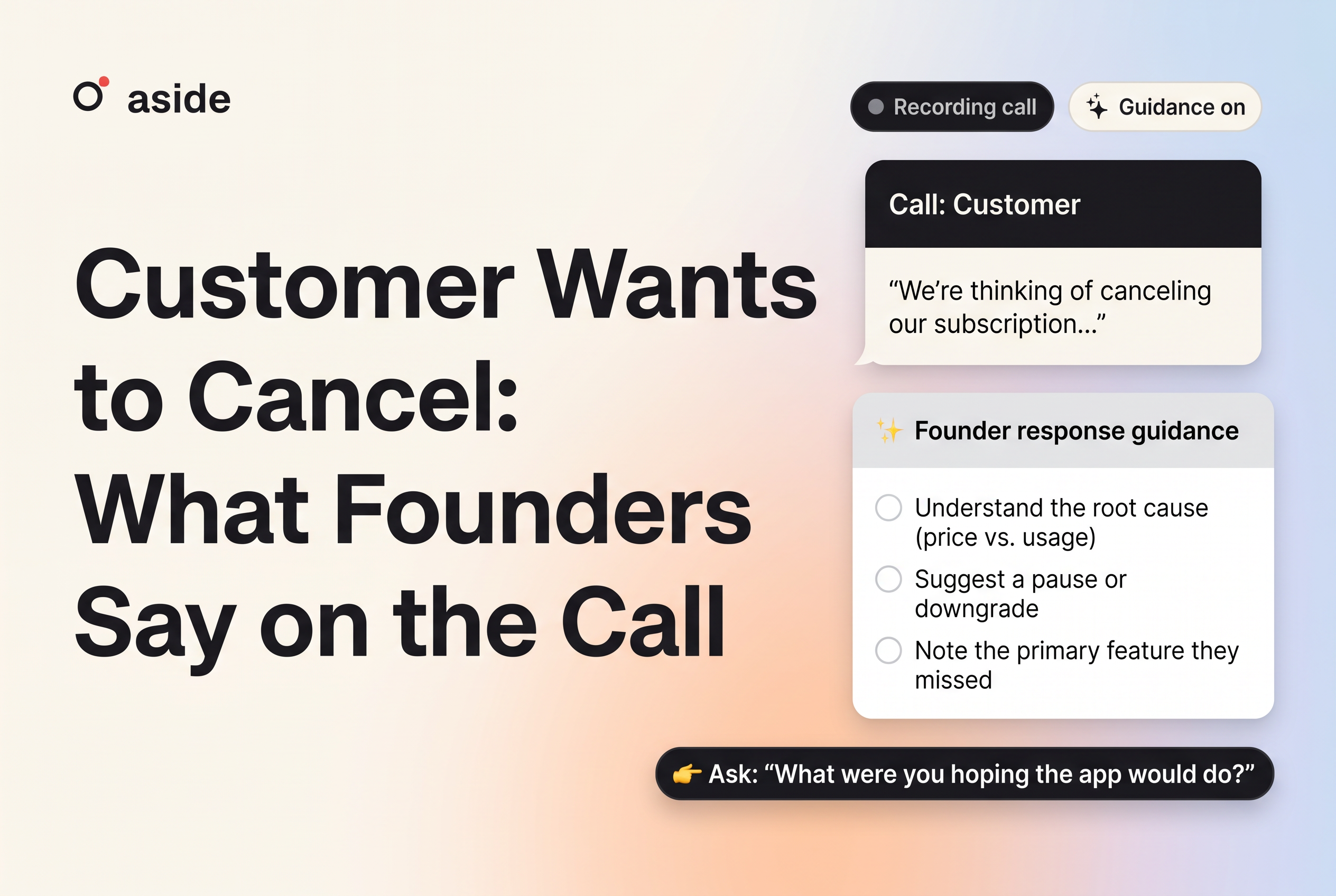
When a customer wants to cancel, say this: "I can help with that. Can I ask what's behind it?" Then listen, match one offer to the real reason, and if they still want out, cancel cleanly and confirm the end date. That's the whole call. The rest is staying calm enough to do it.
I've run these calls as a founder, where there's no retention team and no script taped to a monitor. The failure modes are always the same. You get defensive, you pile on three discounts at once, or you go silent and accept the cancellation without learning anything. This post gives you the exact words for each moment, plus what to do about refunds and the customers you should let go.
The first 30 seconds: what to say when a customer says they want to cancel
Acknowledge first, then ask nothing clever. The first 30 seconds decide whether the customer feels heard or cornered, and cornered customers dig in.
Here's what I say: "Thanks for telling me directly. I can take care of that. Before I do, mind if I ask what's prompting it?" Three moves in two sentences. I thank them, I promise the outcome they came for, and I ask one question.
Don't say "Oh no, why?" and don't open with an offer. An offer before you know the reason tells the customer you were waiting with a discount in your pocket. It also guesses wrong half the time. Someone leaving over a missing feature doesn't want 20% off.
Keep your voice slower than feels natural. Cancellation calls spike your pulse because it feels personal, especially when you built the product. It usually isn't personal. It's a budget line, a change of priorities, or a tool that didn't fit.
Ask once why, then match one offer to the real reason (pause, downgrade, fix, or nothing)
Ask why exactly once, then match a single offer to the answer you hear. Asking twice sounds like an interrogation. Offering three things sounds like begging.
Most reasons fall into four buckets, and each has one matching move:
"We're swamped / it's a quiet season." Offer a pause. "I can pause the account for two months and pick it back up when you're ready."
"It's too expensive for what we use." Offer a downgrade. "There's a lighter plan that fits how you actually use it. Want me to switch you instead?"
"This one thing doesn't work / is missing." Offer a fix, but only a real one. "I can get that sorted this week. If it isn't done by Friday, cancel with no questions." Never promise a feature you can't ship.
"We just don't need it anymore." Offer nothing. Say, "Understood. I'll cancel it now."
That last bucket matters most. Founders lose goodwill by fighting a decision that's already made. If the reason is final, honoring it fast is the retention play, because the customer remembers you as the person who made it easy.
After the offer, stop talking. Let them answer. If they say no, you say, "No problem, I'll take care of it." One offer, one answer, done.
If the real reason is price, the same instincts apply as in any price objection on a sales call: find out whether it's budget or value before you touch the number.
What to say when the customer asks for a refund (and how to politely ask for one yourself)
When a customer asks for a refund, say yes or no to the principle first, then work out the amount. Don't bury the answer in policy language.
If they're inside your refund window or clearly never got value, say: "Of course. I'll refund this month and you'll see it back in a few business days." Fast and unfussy beats a grudging partial refund every time. A refund costs you one month of revenue. A bad review or a chargeback costs more.
If they're outside the window, don't hide behind "policy." Say: "I can't refund the months you've already used, but I can cancel today so you aren't billed again. Does that work?" Then hold the line kindly. It's fine to offer something in between, like refunding the most recent charge, if you decide that in advance rather than improvising under pressure.
Decide your refund rule before the call. Write it down: window, what's covered, who approves. Founders who invent policy mid-call end up inconsistent, and customers talk to each other.
The mirror case is when you need a refund from a vendor. The polite version is short: "I'd like to cancel and request a refund for this billing period. I haven't used it since [date]. Can you confirm what you can do?" Give the date and the ask in one breath. Specifics get approved. Vague complaints get a canned reply.
How to cancel a client nicely, and when to let a customer go
To cancel a client nicely, tell them plainly it isn't working, give a clear end date, and offer a handoff. Don't blame them and don't over-explain.
The script: "I've enjoyed working together, but I don't think I'm the right fit for what you need now. I'll finish through [date] and send over everything you need to move on. Is there anything specific you'd like handed off?" Honest, short, and it leaves the door open.
When to get rid of a customer is a judgment call, but these are signs it's time:
They cost more to serve than they pay, and a price change was already refused.
They routinely break the terms, such as late payments or scope that keeps growing. (If scope is the issue, try the scope creep conversation first.)
They're abusive to you or your team. No contract justifies that.
They need something your product will never become, and keeping them drags the roadmap off course.
One bad month isn't a reason. A pattern is. And don't fire a customer in anger. Sleep on it, then do it on a call with the same calm script, not an email you'll regret.
Letting go well also applies when they're the ones leaving. A customer who departs on good terms refers people. One who leaves feeling trapped tells everyone.
Close the call: confirm the end date, the next step, and what you will send
Close by stating three things out loud: when the service ends, what happens next, and what you'll send. Ambiguity is where billing disputes are born.
Here's the close I use: "So to confirm, your plan ends on the 30th, you won't be charged again, and I'll email you a confirmation today. If you want your data exported before then, tell me now and I'll include it." Four sentences, nothing left open.
Then send exactly what you promised, same day. A confirmation email with the end date, the refund amount if there is one, and a line saying they're welcome back. That last line costs nothing, and some customers do return when their situation changes.
End warmly. "Thanks for giving it a go, and thanks for being straight with me about why." You're not trying to win the call. You're trying to leave a clean record and a good last impression.
Capture the reason without a bot: how Aside gives you your next move live and writes the notes afterwards
Aside is a Mac and Windows app that records calls on your computer and writes up notes, goals reached and next steps, with optional live guidance on screen. That fits cancellation calls well, because the two things that go wrong are freezing mid-call and forgetting the real reason afterwards.
Optional live guidance shows your next move and what to say next. You aren't improvising on the one call where improvising hurts. No bot joins the call, so the customer isn't staring at a stray "notetaker has joined" participant at an already tense moment.
After the call, Aside writes up the notes, goals and next steps, so the cancellation reason lands in a record instead of your memory. Over a few weeks that record shows you patterns: three cancellations for the same missing feature is a roadmap decision, not a coincidence.
On privacy: audio is transcribed on your device for English and 24 other European languages, never uploaded in that case, and nothing is used to train AI models. The free plan covers unlimited recording, notes and transcripts, with live guidance and a write-up on 2 calls a week. New accounts get 14 days of Pro with no card needed.
Quick answers: the 10/5/3 rule and other questions founders ask
The 10/5/3 rule in customer service is a hospitality-style habit: when you're within 10 feet of a customer, make eye contact and smile; within 5 feet, say hello. The "3" is sometimes added as a three-second response window, though versions differ by company. It's a courtesy rule for in-person service, not a cancellation framework, but the spirit carries over: acknowledge people quickly and warmly.
For a call, translate it into timing. Acknowledge the cancellation in the first few seconds, ask your one question, and confirm the outcome before you hang up. The FAQ below covers the rest.
Make the next cancellation call your calmest one
A good cancellation call is short: acknowledge, ask once, offer one matched thing, and let them go if they still want to. The founders who retain the most customers are the ones who never make leaving hard. Before your next call, prepare your four reason buckets and your refund rule, then run the call with Aside providing live guidance. Download it free and take the 14-day Pro trial, no card needed.
Questions
How to cancel a client nicely?
Be honest and brief. Say it isn't the right fit now, give a firm end date, and offer a handoff of files or a referral. Don't blame them or over-explain. Aside can record the call and write up the agreed end date and next steps, so nothing about the wind-down is left vague.
What is the 10/5/3 rule in customer service?
It's a courtesy habit from hospitality: eye contact and a smile within 10 feet, a greeting within 5 feet, and a quick response window tied to the 3. Versions vary by company. For calls, apply the spirit: acknowledge fast, ask one question, and confirm the outcome before ending.
When to get rid of a customer?
Let a customer go when they cost more than they pay and refuse a price change, repeatedly break terms, abuse your team, or need something your product will never become. One bad month isn't enough; a pattern is. Do it calmly on a call, never in anger.
What to do when a customer asks for a refund?
Decide yes or no on the principle first, then the amount. Inside your window, refund quickly and without friction. Outside it, cancel today so they aren't billed again and offer any middle ground you set in advance. Write your refund rule down before the call so you aren't improvising.
How do you politely say you want a refund?
Keep it specific and short: "I'd like to cancel and request a refund for this billing period. I haven't used it since [date]. Can you confirm what you can do?" A date and a clear ask get approved faster than a general complaint.