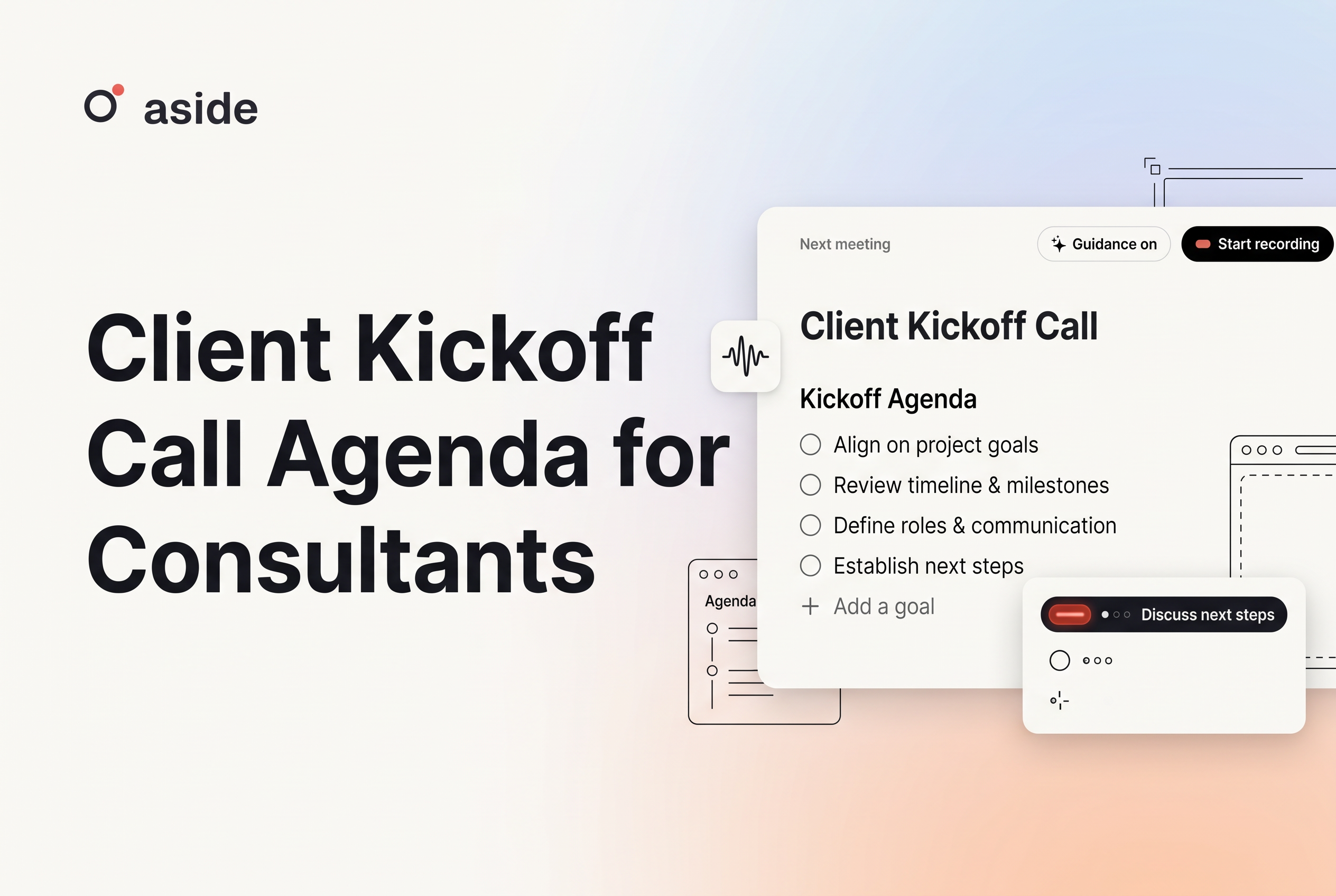
A client kickoff call agenda for a solo consultant has eight segments across 60 to 90 minutes: introductions, purpose and success measures, scope, timeline, decision rights, ways of working, risks, and first steps with owners and dates. Run it in that order and you leave with a shared definition of the project instead of a vague sense that everyone is excited.
The proposal is signed. The temptation is to jump into work. Resist it for one hour. The kickoff is where scope stops being a PDF and becomes something the client can repeat back to you, and where you find out who actually signs off on deliverables.
Below: the agenda with timings, scripts for the three segments that go wrong most often, the email to send beforehand, and how to capture the call and turn it into a written recap the same day.
What a client kickoff call is for (and how it differs from the discovery call)
A kickoff call confirms how the project will run after the deal is already closed. A discovery call decides whether there is a project at all.
Discovery is about the client's problem and whether you are the right person. Your job there is to ask, probe and qualify. The kickoff assumes all of that is settled. Your job now is to align on purpose, boundaries, decision-making and the work that starts this week. If you want the pre-proposal side, see scoping call questions for consultants before a proposal.
The test is simple. After the kickoff, can both sides name the first three actions, who owns each, and the date each is due? If not, the call did not do its job.
Three outputs matter more than anything else you say:
Scope, including what is excluded and how changes are handled.
Decision rights: who approves what, and how fast.
First steps with owners and dates.
The client kickoff call agenda: 8 segments with timings
Plan for 60 to 90 minutes. A typical solo engagement fits comfortably in 75. Here is the agenda with timings you can paste into your calendar invite.
Introductions and roles (5 to 10 min). Who is in the room, and who is your day-to-day contact?
Project purpose and success measures (10 to 15 min). Why now, and what measurable outcome tells everyone this worked?
Scope, deliverables and exclusions (10 to 15 min). What is in, what is out, how scope changes get handled.
Timeline and dependencies (10 min). Milestones, approval dates, and what the client must provide and by when.
Decision rights and approvals (10 min). Who signs off on each deliverable and the expected review turnaround.
Ways of working (10 min). Meeting cadence, channels, response times, where files and decisions live.
Risks and assumptions (5 to 10 min). Likely blockers, with an owner for each.
First steps and questions (5 to 10 min). Actions, owners, due dates.
This answers the question of what should be discussed in a project kickoff meeting. If someone asks for five things to include in any meeting agenda, the short version is purpose, the people involved, the decisions to be made, the timing, and the next steps. Every one of those is covered above.
Protect the high-risk segments first. Scope and decision rights cause most downstream pain, so guard their time. If the call runs long, cut introductions and ways of working, never those two.
What to say at each step: scripts for scope, decision rights and ways of working
The three segments below are where consultants most often stay vague. Use these lines as starting points and adjust the wording to your own voice.
Scope (segment 3). Say it out loud, including the exclusions, even though it is in the proposal.
"I want to read back what we agreed so we are looking at the same thing. The deliverables are X, Y and Z. These are not included: A and B. If something comes up that sits outside that list, I will flag it to you in writing with the time and cost impact before I start on it. Does that match your understanding?"
Then stop talking. Silence is where the client says "actually, we assumed B was in." Far better to hear that now. If it comes up later, you are in a scope creep conversation with less goodwill and less leverage.
Decision rights (segment 5). Ask who, not whether.
"For each deliverable, who gives the final yes? And if that person is unavailable, who can approve instead? I will need feedback within three working days of each delivery to hold the timeline. Is that realistic on your side?"
Write down names. The classic failure is a champion who is friendly on the call and has no authority to approve anything. If the approver is not on the call, ask for a short intro this week.
Ways of working (segment 6). Offer a default and let them edit it.
"My suggestion: a 30-minute check-in every Thursday, email for anything that needs a decision, and one shared folder for files. I reply within one working day. What would you change?"
A proposal they can amend gets agreed faster than an open question like "how do you like to communicate?"
Close the last segment as a read-back: "Here are the first steps as I have them. Owner, action, date." Every line gets a name and a date. "Soon" is not a date.
The kickoff agenda email to send before the call
To write an email for a kickoff meeting, keep it to a subject line that names the call, the agenda in a short list, and one ask: what the client should bring or confirm. Send it 24 to 48 hours ahead so nobody is improvising on the call.
Here is a template that works as a good example of a meeting agenda in email form:
Subject: Kickoff call [day, time]: agenda and two things to bring
Hi [Name],
Looking forward to starting on [day]. We have [75] minutes. The plan:
Introductions and roles (5 min)
Purpose and success measures (15 min)
Scope, deliverables and exclusions (15 min)
Timeline and dependencies (10 min)
Decision rights and approvals (10 min)
Ways of working (10 min)
Risks and first steps (10 min)
Two things that would help: (a) the name of whoever approves final deliverables, and (b) any access or documents you can already share.
I will send a written recap the same day.
[Your name]
That last line matters. It tells the client the call has consequences and sets the expectation that what is said on the call gets written down.
Capturing the kickoff without a bot: notes, goals reached and next steps with Aside
The hardest part of a kickoff is that you are running the agenda, listening for what the client skips, and trying to remember who promised what. Typing notes while doing all that costs you eye contact and the thread of the conversation.
Aside is a Mac and Windows app that records calls on your computer and writes up notes, goals and next steps. No bot joins the call. Your client sees no extra participant named "Notetaker" arriving on Zoom, Google Meet, Microsoft Teams, Slack huddles or FaceTime, and it stays out of screen shares. For a client who has just signed with you, a bot in the room is an odd way to start a relationship.
A few facts that matter for consultants handling client information: English and 24 other European languages are transcribed on your computer, and nothing is used to train AI models. Text syncs to your account.
Here is how it fits the agenda. Treat the segments as your goals for the call: scope confirmed, approver named, cadence agreed, first steps assigned. After the call, the write-up shows the notes, goals and next steps.
To flag something mid-call, press Ctrl+Alt+N on Windows or ⌃⌥N on Mac and add a note from any app. Free forever covers unlimited recording, notes, transcripts and speaker names, plus live guidance and a write-up on 2 calls a week. New accounts get 14 days of Pro with no card, which covers a write-up on every call, summaries and a follow-up email. Check the requirements first: Apple silicon Mac on macOS 14.2 or later, or Windows 10 (2004+) or Windows 11 on x64.
The same-day recap: turning the call into a written agreement
The recap is the real deliverable of the kickoff. Send it the same day, while the client still remembers the call and before anyone has had time to quietly reinterpret what was agreed.
Keep it to four blocks:
Scope: deliverables in, exclusions out, and how changes are handled.
Decisions: who approves what, and the agreed review turnaround.
Ways of working: cadence, channels, response times, where files live.
First steps: a table or list of action, owner, due date.
End with one line: "If anything here does not match your understanding, reply by [date] and I will correct it." Silence then counts as agreement, and you have a written reference when a boundary is tested. That is especially useful when a rate or scope question resurfaces, as in consulting rate pushback.
This is where the Aside write-up earns its keep. The notes, goals and next steps are already drafted when the call ends, so you edit rather than reconstruct from memory. On Pro, the follow-up email is drafted for you too. You still read it and make sure it says what you promised. The same-day recap takes ten minutes, not an evening.
Kickoff call mistakes consultants make
Most kickoff failures are not dramatic. They are small omissions that compound for weeks.
Skipping exclusions. Saying what is in scope without saying what is out leaves room for the client's assumptions. Name two or three exclusions every time.
Never identifying the real approver. A friendly contact is not a decision-maker. Ask by deliverable who gives the final yes.
Treating the kickoff as a sales call. The deal is signed. Don't re-pitch. Spend the time on alignment.
Leaving with intentions instead of dates. "We'll get you the access" is not a first step. "Priya sends admin access by Friday" is.
Over-stuffing the agenda. Ninety minutes is the ceiling. If you need more, split into two calls rather than rushing the decision-rights segment.
Sending the recap tomorrow, or never. A recap that arrives three days later gets debated. One that arrives that afternoon gets confirmed. Capture the call properly so same-day is easy, and so you can check whether your proposal follow-up matched what you promised.
Run the next kickoff with Aside recording and send the recap by end of day
A kickoff earns its hour by producing three things in writing: scope with exclusions, named approvers with turnaround times, and first steps with owners and dates. The agenda gets you there, but the same-day recap is what makes it stick. For your next kickoff, send the agenda email, turn the eight segments into the goals for the call, and let Aside record on your computer with no bot. Then edit its notes, goals and next steps into the recap before you close your laptop. Start free at asidehq.app; new accounts get 14 days of Pro.
Questions
What should be discussed in a project kickoff meeting?
Cover introductions and roles, project purpose and success measures, scope with exclusions, timeline and dependencies, decision rights, ways of working, risks and assumptions, and first steps with owners and dates. Aside can record the call with no bot and draft notes, goals reached and next steps for your same-day recap.
What are 5 things you would include in a meeting agenda?
Include the purpose of the meeting, the people involved and their roles, the decisions to be made, the timing for each topic, and the next steps with owners and dates. For a client kickoff, those map to the purpose, roles, scope and decision rights, timeline, and first steps segments.
How to write an email for a kick-off meeting?
Use a subject line naming the call and time, list the agenda with minutes per item, and ask for one or two things to bring, such as the name of the final approver. Send it 24 to 48 hours ahead and promise a same-day written recap.
How long should a client kickoff call be?
Plan for 60 to 90 minutes. Most solo consulting engagements fit in about 75 minutes across eight segments. If you need more, split it into two calls rather than shortening the scope and decision-rights segments, which cause the most trouble later.
Can I record a client kickoff call without a bot joining?
Yes. Aside records calls on your Mac or Windows computer with no bot joining Zoom, Google Meet, Teams, Slack huddles or FaceTime, and it stays out of screen shares. It then writes notes, goals reached and next steps. Let your client know you are recording, as you would on any call.